Showing posts with label bilingual. Show all posts

Friday, July 29, 2016

Bilingually Mourning, Shiva in Two Languages

Since the 7 Day Shiva Candle was only lit halfway through shiva for my brother, it's still burning strong.

Or you can also call this post:
The Advantage/Adventure of Being Bilingual!
After close to forty-six, our 46th Aliyah Anniversary is in less than two months, years in Israel I've reached the point where I can rather easily switch between Hebrew and English pretty much mid-sentence. And many of our anglo friends are the same.

Even among friends more veteran here, and there aren't too many, English is still the language we prefer for conversing among ourselves. So while I was sitting shiva for my brother this week, a very good portion of the time you'd here only English. But then, if suddenly a Hebrew speaking neighbor would enter, they'd follow my lead and even mid-sentence switch into Hebrew. At no point did I have over anyone in the anglo crowd totally incapable of following the switch.

Shiloh isn't known as one of those "English speaking" places like Gush Etzion or Ramat Beit Shemesh, but there are quite a few anglos and bilinguals from birth, like my kids can be called. They are the Israelis who grew up hearing, and usually speaking, English at home but functioned in Hebrew outside. So, they appear to be regular Hebrew-speaking Israelis, but not only do they know English well, frequently as if they had been a foreign country, their culture and sense of humor are very binational.

That's it for now. Today is Friday, and I have so much to do... Back to ordinary life, thank Gd.

Sign is down, and Shiva is over

Tuesday, April 28, 2015

Jewish Israeli Holiday Special!

This is a book I won't give away!

I generally give away the books I get to review once I'm finished reading and reviewing them, but my new, beautiful Koren Mahzor for Yom Ha'atzmaut & Yom Yerushalyim is staying with me!
The Koren Yom Ha’Atzmaut Mahzor is the first-ever English-Hebrew prayer book for Israel’s national holidays. It includes complete services for Israel’s Independence Day and Jerusalem Day according to the practices established by the Chief Rabbinate of Israel. The mahzor features a moving introduction by Rabbi Shlomo Riskin, translation by Rabbi Jonathan Sacks, commentary by Rabbi Moshe Taragin and Rabbi Binyamin Lau, and a unique collection of essays by other leading scholars in the world of Religious Zionism. Optional prayers such as Hallel and Al-HaNissim are shaded and include extensive notes that explain the halakhic debates surrounding their recitation. 
Not only is this new Koren sensation complete and easy to read, but it's full of fascinating essays including one by my favorite Tanach (Bible) teacher, Dr. Yael Ziegler.

Hallel on Israeli
Independence Day,
Shiloh Mishkan (Tabernacle)
Synagogue, 5775, 2015
In Shiloh we doven the complete Holiday service including the Hallel with a blessing, according the psak, rabbinic decision of the Shiloh Chief Rabbi Elchanan Bin-Nun, whose brother Rav Yoel also has an essay included in the Machzor.

Besides the prayers for Israeli Independence Day and Jerusalem Day, there is also a section for Memorial Day. Yes, this is the complete package and perfect gift for yourself and others.

Even if you don't need this very first bilingual Mahzor for Yom Ha'atzmaut & Yom Yerushalyim for the English when you are praying you will enjoy the essay section. It is a very valuable addition to one's home library. And certainly congregations of English speakers, here in Israel or abroad, that hold Prayers on Israeli Memorial Day, Independence Day and Jerusalem Day should have this Machzor available.

I received it after Independence Day but look forward to praying from it on Jerusalem Day, G-d willing.

ISBN9789653016651
AuthorJonathan Sacks
Pages281
SizeStandard 5.3x8.5
LanguageHebrew/English
BindingHardcover
NusachAshkenaz

Wednesday, June 04, 2014

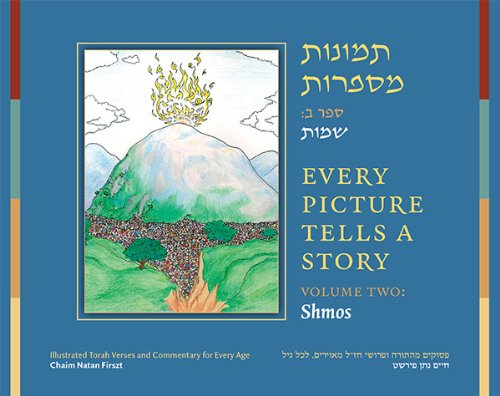
Every Picture Tells a Story... Book Review

EVERY PICTURE TELLS A STORY, VOLUME TWO: SHMOS by Chaim Natan Firszt, Menorah Books, is a bilingual, Hebrew (Ashkenaz pronunciation)- English Bible teaching book for children.

As  you can see from the pictures, my grandchildren were fascinated by it. My grandson immediately began telling us the Biblical stories from the pictures. It's a wonderful book for families which use both Hebrew and English. I would recommend it for grandparents or aunts and uncles who speak and read only one of the languages, while the grandchildren or nieces and nephews only speak the other one.
No doubt that everyone will enjoy this great way to learn and teach Parshat Shavua, the Weekly Torah Portion. There is just enough information for children to handle. This is especially helpful for those who don't have the right background and want to teach the children more Torah. It also comes with a companion coloring book to give the children a more kinesthetic learning experience.

Every Picture Tells a Story can be ordered either from Amazon or from Menorah.

Product Code: EPTSV2S
ISBN: 978-1-940516-10-3
Binding: Hardcover / 113 pages
Dimensions: 8.75” H x 11” W
Weight: 0.7 kg / 1.5 lbs
Global Shipping Available

Monday, October 07, 2013

Fun With The Grandkids, Playing with Classic Play-Doh

I try to encourage the grandkids to play with something other than a keyboard and screen.  The most willing is the three year old.


I was happy to find some classic Play-Doh in the closet. That kept her (and me) busy for quite a while.  At one point she decided to turn the "snakes" into jewelry.


This activity was also good for teaching her the names of the colors in English.  At first she'd argue with me, saying that "it's not blue; it's cachol," the Hebrew for blue.  But then after I'd repeat that it's blue a few times, she'd use both words.  We did that for all of the Play-Doh colors plus the balloons I had blown up for her.

My grandkids are being raised in Hebrew, but I speak to them in English.  Sometimes they understand everything I say, such as "wash up," but other times I need a lot of pantomime and a few key words in Hebrew.

PS You have probably noticed that this time she happily posed for me.  And as usual, I'm only posted pictures which make it very difficult to actually see her face.  That's on purpose, not due to photographic ineptitude.

Wednesday, July 22, 2009

Multi-Lingual, What Happened To Our Brains?

There was a time when being multi-lingual was the norm for many, especially Jews. That's why there were always some Jews in the ships that explored the great oceans, like in Columbus's crew.

The more languages a person knows, the easier it is to understand and learn newer ones. And the younger a person is when he/she learns, the easier it is.

When a child is exposed to multiple languages from day one, they are part of his/her speech, basic linguistic development, not "extra" languages.

Just like the medical experts who interfered so in infant feeding that few babies since the twentieth century are given mother's milk until old enough to eat regular food, modern educators and speech therapists made all sorts of rules and charts and insisted that it's "too difficult" for a baby or young child to absorb multiple languages, creating a mono-lingual society.

Suddenly, multilingualism became a rarity. The children of multilingual parents who grew up hearing only one language only found learning a second language in school impossibly difficult.

When I was growing up in mid-twentieth century U.S.A., learning a foreign language was considered "only for the brightest." It was rare to be exposed to a foreign language until high school. When that's the case, it is hard to learn a second language.

It's easiest and best to make sure children grow up on more than one language. It's a painless way of learning. The brain develops in a more flexible way, making it easier to learn more and more languages.

Don't listen to the "experts" who claim that it's best to perfect one before learning another. They're wrong. Even children of lower than average intelligence can be bilingual if that's what they're exposed to.

My five kids all had different patterns in their early speech development. My oldest kids heard mostly English and just a bit of Hebrew when we were out. The younger ones heard mostly Hebrew, except from me. At times they "stopped" using English and only spoke Hebrew to me, but by adolescence they were all bilingual.