Showing posts with label Ramat Eshkol. Show all posts

Thursday, August 11, 2016

Pishers' Guide to Jerusalem #7 A Supermarket to Avoid. Plus WC Tips

This is a continuation in my ongoing series about public toilets in Jerusalem. See #6,  #5, Saved by The First Station aka #4a, #4, #3, #2 and #1. 

For those of us who really need and use public toilets, you should know that there are some in supermarkets. In general I've had some excellent experiences in them. At work in Sha'ar Binyamin, the nearby one is in Rami Levy, which I, bli neder*, must review. On occasion, there may be a mess, but the store's cleaning crew keeps it clean and well stocked with toilet paper. I've also been to a couple of Super Sol branches, which were perfectly acceptable.

That's why I had absolutely no trepidations entering the former Super Sol in the Ramat Eshkol Shopping Center. This is one of Israel's very first purpose built shopping centers, designed after the 1967 Six Days War for the Ramat Eshkol neighborhood, which had many western immigrants. There are very few public toilet options there. I've never tried the gas station, and small stores and restaurants generally restrict access to patrons. So, since I needed the facilities, and the supermarket was the first option on my route, I went in. It's now called יש Yesh.


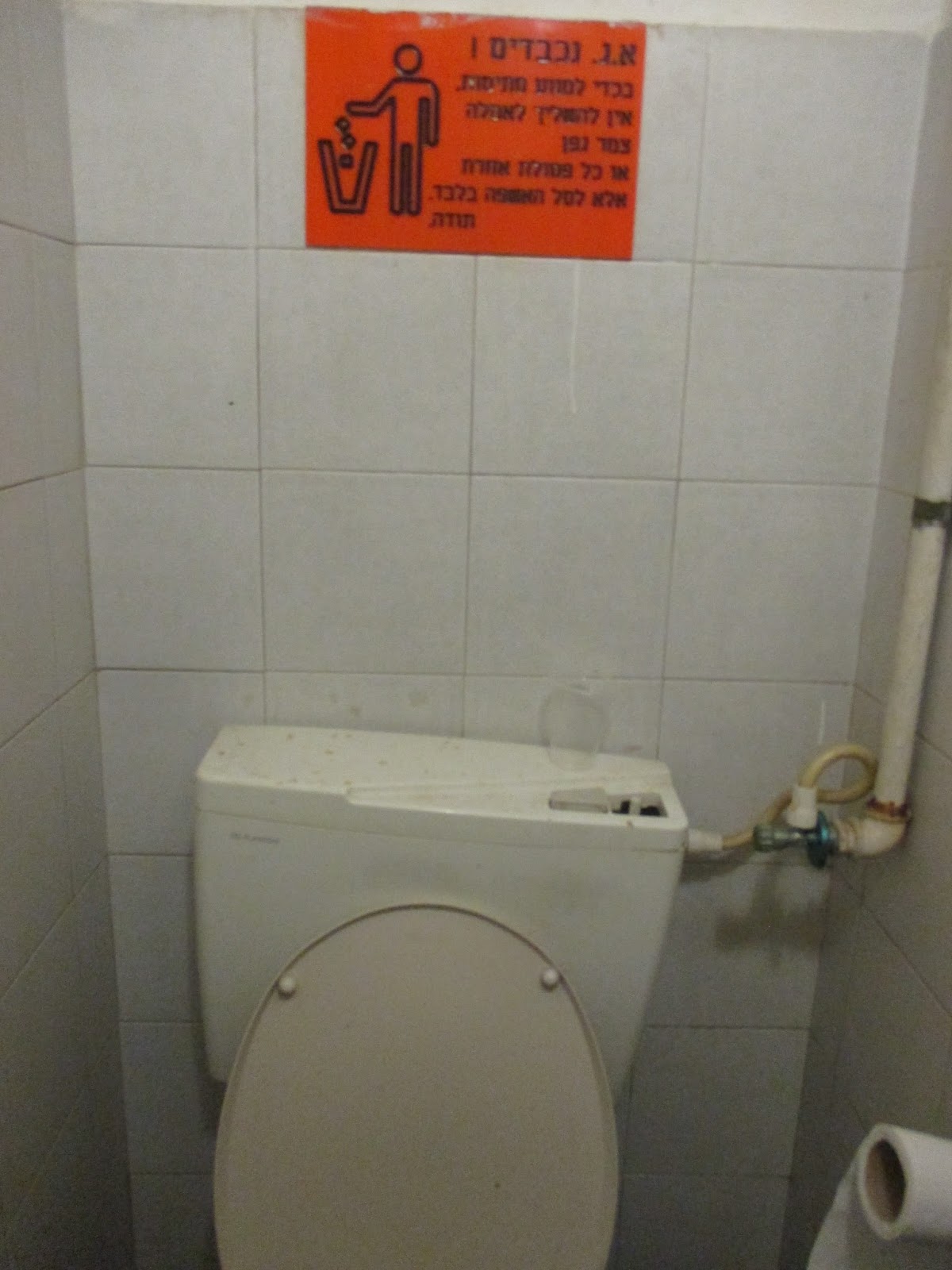
I walked in headed left, looking for signs along the walls and finally followed them into a storage area. A worker gave me directions. I needed to go up a few stairs and make a couple of turns. The further I went, the worse the place looked and smelled. If you have a good nose, you can probably find it by the scent. I certainly wasn't expecting that. My Rami Levy branch is cleaned and washed frequently. And of course the Yesh WC isn't handicapped accessible.

When I was planning this post, I thought of writing that the toilet hadn't been renovated since Super Sol opened the building in 1970-71, but it isn't technically true. I can see that the toilet itself has been replaced since then. It's a model that didn't exist forty-five years ago.

But the whole set-up there is awful. I'd have to be very, very desperate to avail myself on those facilities again. Within five minutes I could have walked to the Kupat Cholim, sick fund, clinic across the way and down the street. All sick fund clinics in Israel are supposed to have public toilets. Nobody has ever requested a membership card from me as a condition of use. And there's also the gas station... but I usually avoid them. Maybe it's time to overcome that phobia...

*Bli neder means, not a vow, so don't hold me to it.

Thursday, May 22, 2014

Jerusalem Day, Celebrating Ramat Eshkol

Ramat Eshkol was one of the very, very first new neighborhoods built after Israel's glorious and miraculous victory in the 1967 Six Days War. Unlike some of the other post-1967 Six Days War, it's a very natural continuation of pre-existing Jewish neighborhoods, which had been on the very dangerous border with Jordanian snipers, such as Sanhedria and Shmuel Hanavi.


It was public housing at its best for immigrants and young families. Not only were apartments of all sizes built, but it had land allocated for the wealthier where they could build private homes. There's a large shopping center which is still vibrant and popular.

nice landscaping to this day

Since the apartments were offered at minimum prices to the western immigrants who began making aliyah in the post-1967 Ramat Eshkol was also planned with parking lots among the buildings.


This was the first time that parking lots were made as part of neighborhoods. Before then and for another decade, private cars were still very rare in Israel. Even during and in the aftermath of the 1973 Yom Kippur War, private cars were drafted by the IDF for "reserve duty." The army didn't have the budget for ordinary vehicles. Also one of the perks of being an MK was a free pass on all public buses, which was taken advantage of by Knesset Members. Even up to the 1980's it wasn't a rare sight to see MKs on the bus going to work and doing ordinary chores, like shopping in the shuk.

Even today, forty-five 45 years after being built, it's shopping center is busy, popular and vibrant with a great variety of stores.


One thing that has changed is the population. In the 1970's, there were mostly young families from all over the world, religious, secular and traditional. Today the veteran residents are much older, and there are many chareidim (known as ultra-Orthodox) who live there, because it is near older chareidi neighborhoods but much nicer.


Many people don't even realize that Ramat Eshkol is a post-Six Days War neighborhood, because it so successfully and seamlessly became part of Jewish Jerusalem. But you should remember that to the American Government, it is no different than Shiloh or Yitzhar.

Tuesday, March 18, 2008

Grazing in Ramat Eshkol

Ramat Eshkol is probably the first big neighborhood built in liberated Jerusalem after the Six Days War. Its large shopping center is also Jerusalem's first. There are a great variety of stores, and it's hard to be there without buying something. I was there with my daughter and grandson this week, and she enjoyed it.

Ramat Eshkol was built relatively quickly with great enthusiasm and a mistake or two. There's a bridge over a side street, Yaakov Netter Street, which was really supposed to cross adjacent Sderot Eshkol Boulevard, but the builders didn't look carefully at the map, and the inspectors didn't understand the details of the massive project.

This sight used to be common in Jerusalem. I remember seeing sheep and goats near my Bayit V'Gan, Jerusalem apartment in the 1970's.

I took this picture from the bus, dirty double bullet-proof Windows. We were at the Ammunition Hill end of Eshkol Boulevard.