Showing posts with label Alzheimer’s disease. Show all posts

Tuesday, August 13, 2019

The Lost Kitchen, A Book Review


Miriam Green, author of The Lost Kitchen
and I finally met in person
Last week while waiting for one of the classes to begin at Herzog College's amazing Tanach/Bible Yemei Iyun, I heard my name called. It was Miriam Green, fellow blogger and facebook friend. We finally got to meet in person f2f. I've been a fan of Miriam's blog The Lost Kitchen for the longest time. First of all it's a well-written honest blog. It's posted weekly and follows the saga of Miriam's mother's life with Alzheimer’s. Each post is accompanied by a recipe.

Alzheimer’s and/or one (or more) of the more difficult to diagnose/name dementias dominated both my parents' final years, so I'm neither objective nor inexperienced when it comes to the topic.

The Lost Kitchen is a brilliant way of titling the blog, book and Miriam's mother, Naomi. One of the first skills many people lose is caring for themselves, knowing what to shop for, remembering to turn off the stove, prepare food and even remembering to eat.

Green's book opens with her mother's diagnosis of Alzheimer’s. I was really spooked by the fact that her mother was younger than I am now. We're spared the difficult period before that made them suspect that something was very wrong and getting worse. The focus of The Lost Kitchen is how Jack, her father, and Miriam deal with the constant deterioration, challenges and dilemmas of Naomi's Alzheimer’s. Miriam's original idea was to write a cookbook chronicling Jack's unplanned introduction to cooking and the recipes he has adopted for himself as cook.

Even though I'm a loyal follower of the The Lost Kitchen blog, I found reading the book to be a new experience. I wasn't bored. The Lost Kitchen book isn't a simple compilation of the blog. Besides recipes, there are poems. If you like the blog, you'll love the book. And if you've never read the blog you'll find the book a wonderful loving memoir following the gradual loss of a loving mother.

The Lost Kitchen begins after the diagnosis, when Jack is still able to care for Naomi.  At first he manages with Miriam's weekly visits, but then as the Alzheimer’s gets worse, it's clear he needs more help and then even more. Their story is honestly and sensitively told by Miriam.

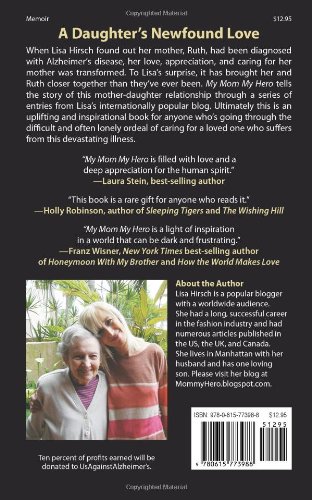
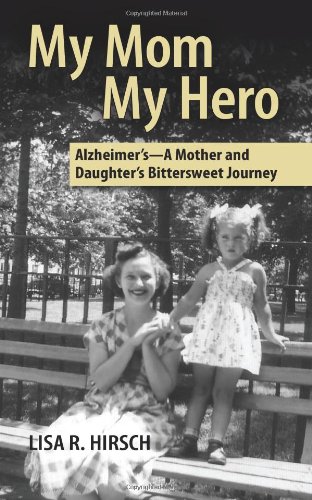
Dealing with Alzheimer’s seems to be a growing genre as people live longer, and their bodies outlive their cognitive abilities. I reviewed My Mom My Hero by Lisa Hirsch a few years ago, which was written by a childhood friend. Last I heard, her mother is still alive.

I recommend reading The Lost Kitchen, whether you've had to deal with a loved one's Alzheimer’s or any other form of dementia or not. After a half a century in Israel, I sometimes forget that there's a whole other world out there in other countries, and life can be very different. The Lost Kitchen is also a Jewish Israeli story, because the assistance, facilities, society and health care system are probably specific to Israel. Of course the family dynamics and dementia itself, no matter what the specific diagnosis are international. Dementia can happen to anyone, anyplace and any age, due to all sorts of causes.

Miriam Green has written a valuable and unique book, a universal story. As a bonus you get a cookbook, which is valuable on its own. Unlike many cookbooks, this one has easy to follow recipes, without too many exotic, hard to find ingredients. The poems add a gentle touch. Yes, if I haven't been clear, I highly recommend buying The Lost Kitchen for yourself or as a gift for others.

Product details

  • Paperback: 274 pages
  • Publisher: Black Opal Books (May 4, 2019)
  • Language: English
  • ISBN-10: 1644370816
  • ISBN-13: 978-1644370810
  • Product Dimensions: 5.2 x 0.7 x 8 inches
  • Shipping Weight: 11.4 ounces (View shipping rates and policies)

Saturday, January 16, 2016

Looks are So Deceiving: Dementia, Alzheimer’s, Senility...


Far from their native New York, in Arizona and Florida, two former neighbors are in very similar conditions. As I've written many times, my father is in a "memory care center," since although he can still walk around, feed himself and enjoy company and all, he can no longer "take care of himself." And our former next door neighbor in Great Neck, Ruth, who had also been a neighbor in Bell Park Gardens, Bayside, is in Florida, also needing care. Her daughter Lisa writes about what they are experiencing.

Looking at photos like these, you wouldn't have a clue that something was amiss or missing in his brain. Even though he can walk around, for safety uses a "walker," feeds himself and carefully wipes his face with a napkin, he can't be left on his own.

Apparently there are dozens, if not hundreds of types of dementia and in many cases, they are combined. Nothing about old age is simple. And people don't die from dementia as a primary cause. If they aren't in a proper setting with readymade food and caregivers, they can die of starvation, malnutrition, not caring for injuries or taking too few or too many medications.

In actuality, dementia only affects the brain, not anything else. And of course there are other people of his age who "have all their marbles" but are incapable of moving around independently...


Friday, March 20, 2015

My Mom My Hero, Book Review


First of all, I must admit that there's nothing objective about my relationship to this book, My Mom My Hero, by Lisa Hirsch. It was due to Hirsch's publicizing the book on a facebook page that I rediscovered Lisa and renewed our friendship. Lisa and I had grown up together in Bell Park Gardens, Bayside, NY and then were next-door neighbors in Great Neck, NY. Her parents were family friends.

Now that I've admitted this, I must tell you about the book. It's based on the journal-like blog, Alzheimer's - My Mom My Hero, Lisa has been writing about how she deals with her mother Ruth's Alzheimer’s disease. Lisa writes with great openness and honesty, not only about her mother today but about her childhood relationship with her.

Many of us, of our generation, who have surviving parents are dealing with the same sort of problems and situations. Most frequently, the brain does not stay as sharp as the body. In other cases, it's the body that can no longer function as well as the brain. Old age is no picnic for sure, and dealing with parents who are no longer capable of making basic decisions or care for themselves is a very complicated situation. My siblings and I have also been dealing with these issues. Our father is now in what's called a "memory center," where he is cared for 24/7. He's physically hearty, but needs help with his daily care.

Ruth Elian, Lisa's mother, still has her sense of humor, although she sometimes forgets the name of her daughter. Lisa chronicles her vists and phone calls. This is not a depressing book. It's joyful and a must-read, especially for those who are facing or expecting to face such a situation. Actually, it's a book that everyone should read. There's a lot of wisdom. It's written simply and honestly.


  • Paperback: 200 pages
  • Publisher: Logan Shawn Press (March 15, 2013)
  • Language: English
  • ISBN-10: 0615773982
  • ISBN-13: 978-0615773988
  • Product Dimensions: 5 x 0.5 x 8 inches
  • Shipping Weight: 8.5 ounces (View shipping rates and policies)
  • File Size: 888 KB
  • Print Length: 202 pages
  • Page Numbers Source ISBN: 0615773982
  • Simultaneous Device Usage: Unlimited
  • Publisher: Logan Shawn Press (March 8, 2013)
  • Sold by: Amazon Digital Services, Inc.
  • Language: English
  • ASIN: B00BZC9LBQ
  • Text-to-Speech: Enabled 
  • X-Ray:
  • Word Wise: Enabled
  • Lending: Not Enabled