Showing posts with label dementia. Show all posts

Tuesday, August 13, 2019

The Lost Kitchen, A Book Review


Miriam Green, author of The Lost Kitchen
and I finally met in person
Last week while waiting for one of the classes to begin at Herzog College's amazing Tanach/Bible Yemei Iyun, I heard my name called. It was Miriam Green, fellow blogger and facebook friend. We finally got to meet in person f2f. I've been a fan of Miriam's blog The Lost Kitchen for the longest time. First of all it's a well-written honest blog. It's posted weekly and follows the saga of Miriam's mother's life with Alzheimer’s. Each post is accompanied by a recipe.

Alzheimer’s and/or one (or more) of the more difficult to diagnose/name dementias dominated both my parents' final years, so I'm neither objective nor inexperienced when it comes to the topic.

The Lost Kitchen is a brilliant way of titling the blog, book and Miriam's mother, Naomi. One of the first skills many people lose is caring for themselves, knowing what to shop for, remembering to turn off the stove, prepare food and even remembering to eat.

Green's book opens with her mother's diagnosis of Alzheimer’s. I was really spooked by the fact that her mother was younger than I am now. We're spared the difficult period before that made them suspect that something was very wrong and getting worse. The focus of The Lost Kitchen is how Jack, her father, and Miriam deal with the constant deterioration, challenges and dilemmas of Naomi's Alzheimer’s. Miriam's original idea was to write a cookbook chronicling Jack's unplanned introduction to cooking and the recipes he has adopted for himself as cook.

Even though I'm a loyal follower of the The Lost Kitchen blog, I found reading the book to be a new experience. I wasn't bored. The Lost Kitchen book isn't a simple compilation of the blog. Besides recipes, there are poems. If you like the blog, you'll love the book. And if you've never read the blog you'll find the book a wonderful loving memoir following the gradual loss of a loving mother.

The Lost Kitchen begins after the diagnosis, when Jack is still able to care for Naomi.  At first he manages with Miriam's weekly visits, but then as the Alzheimer’s gets worse, it's clear he needs more help and then even more. Their story is honestly and sensitively told by Miriam.

Dealing with Alzheimer’s seems to be a growing genre as people live longer, and their bodies outlive their cognitive abilities. I reviewed My Mom My Hero by Lisa Hirsch a few years ago, which was written by a childhood friend. Last I heard, her mother is still alive.

I recommend reading The Lost Kitchen, whether you've had to deal with a loved one's Alzheimer’s or any other form of dementia or not. After a half a century in Israel, I sometimes forget that there's a whole other world out there in other countries, and life can be very different. The Lost Kitchen is also a Jewish Israeli story, because the assistance, facilities, society and health care system are probably specific to Israel. Of course the family dynamics and dementia itself, no matter what the specific diagnosis are international. Dementia can happen to anyone, anyplace and any age, due to all sorts of causes.

Miriam Green has written a valuable and unique book, a universal story. As a bonus you get a cookbook, which is valuable on its own. Unlike many cookbooks, this one has easy to follow recipes, without too many exotic, hard to find ingredients. The poems add a gentle touch. Yes, if I haven't been clear, I highly recommend buying The Lost Kitchen for yourself or as a gift for others.

Product details

  • Paperback: 274 pages
  • Publisher: Black Opal Books (May 4, 2019)
  • Language: English
  • ISBN-10: 1644370816
  • ISBN-13: 978-1644370810
  • Product Dimensions: 5.2 x 0.7 x 8 inches
  • Shipping Weight: 11.4 ounces (View shipping rates and policies)

Wednesday, August 22, 2018

New Phone, Xiaomi Mi A2, Hope It Lasts

Well, I had no choice. I really can't manage without a smartphone. I bought a new one, a Chinese one, since I was awfully disappointed with my Samsung J7 which didn't even survive two years. I got a Xiaomi Mi A2, and I'm trying to adjust it to my needs.

OK, first where and how did I choose it?

As I had blogged yesterday, my J7 had dropped dead. No, I hadn't dropped it. It never awoke after restart; it was just lying peacefully on my computer desk Sunday evening.

The young man who helped me in Ariel recommended that I don't buy immediately. I should research and then come back. Besides asking around, I emailed the chain and got some suggestions.


Instead of returning to the Ariel phone store, I went to the same AM Phone chain in Sha'ar Binyamin. I knew that buying a phone and getting the service I'd need to transfer data would take ages. Also, even though it would be possible to find the same phone for less money in Jerusalem, I preferred the convenience and trust I have in this one.

It could be that the J7 didn't suit my needs, so I decided not to skimp this time. Davka, surprisingly, my new Xiaomi Mi A2 cost less than the J7 did less than two years ago. One of the factors besides the 64 memory that sold me on the phone was that the camera is supposed to be good. That's one of the things I haven't gotten to know well, though I'm pleased so far. Priorities are the rings and notifications, so it won't wake me up for a Whatsapp message. I also had to download an app for a choice of ringtones. It doesn't have a choice builtin.

Another plus for the Xiaomi phone is the two year service warranty. That beats the one year that Samsung gives.

I'm definitely making progress in learning how to use my Xiaomi Mi A2, and don't forget at the same time there's a new kitchen to set-up and get used to. At my age, I'm always glad to challenge my mind.

I'm not showing a picture of the phone, since it's ugly black. The model is so new that the store didn't have any nice cases for it, but the company gives a free case, also dark and boring.

Saturday, January 16, 2016

Looks are So Deceiving: Dementia, Alzheimer’s, Senility...


Far from their native New York, in Arizona and Florida, two former neighbors are in very similar conditions. As I've written many times, my father is in a "memory care center," since although he can still walk around, feed himself and enjoy company and all, he can no longer "take care of himself." And our former next door neighbor in Great Neck, Ruth, who had also been a neighbor in Bell Park Gardens, Bayside, is in Florida, also needing care. Her daughter Lisa writes about what they are experiencing.

Looking at photos like these, you wouldn't have a clue that something was amiss or missing in his brain. Even though he can walk around, for safety uses a "walker," feeds himself and carefully wipes his face with a napkin, he can't be left on his own.

Apparently there are dozens, if not hundreds of types of dementia and in many cases, they are combined. Nothing about old age is simple. And people don't die from dementia as a primary cause. If they aren't in a proper setting with readymade food and caregivers, they can die of starvation, malnutrition, not caring for injuries or taking too few or too many medications.

In actuality, dementia only affects the brain, not anything else. And of course there are other people of his age who "have all their marbles" but are incapable of moving around independently...


Thursday, December 24, 2015

Blogging About Elderly Parents

my father walking around our Shiloh neighborhood
on the plane to Israel
Six years ago we had my father living with us for almost a year. I blogged about it a lot. Aliyah To The Land of Israel At 89Keeping Busy, Arts, Crafts and ExerciseCasting A ShadowI DID It! The latest episode in the saga of my father's aliyah at 89 and more. In the end, my mother (who was supposed to have joined him in Israel when health permitted) and sister decided that they would be better off in Arizona near my sister, so my son and I took him there. That's where he now is, in a "memory center."

visiting my parents in
Arizona
When he was living with us, I didn't know of any other blogs about taking care of the elderly, coping with dementia and all it entails. Now I follow two blogs about elderly senile (not the modern pc term) parents. One is a very interesting one that combines the saga of the blogger's deteriorating mother with recipes,  The Lost Kitchen: An Alzheimer's Memoir and Cookbook, and the other,  Alzheimer's - My Mom My Hero, which is davka written by a childhood friend of mine. We were even nextdoor neighbors in Great Neck our teens; our parents had been close friends for about forty years beginning in Bell Park Gardens, Bayside, NY, and then until hers moved to Florida.

There are dozens of types of dementia and how it affects the person. No two are identical, though there are patterns and signs that we should be aware of. And sometimes this disability develops so slowly affecting very isolated brain cells that the effect is very subtle and hard and traumatic to recognize.

Monday, June 10, 2013

Proudly Coffeed

There was a time I thought coffee something to be avoided, sort of like chewing gum and chocolate.  I'd proudly drink my fake coffee, counting on my youthful good health to keep my brain sharp and my body energized.

Nowadays over and over articles appear in the news praising the wonders and health benefits of drinking coffee, a few cups a day.  

Other recent studies have linked moderate coffee drinking — the equivalent of three or four 5-ounce cups of coffee a day or a single venti-size Starbucks — with more specific advantages: a reduction in the risk of developing Type 2 diabetes, basal cell carcinoma (the most common skin cancer), prostate canceroral cancer and breast cancer recurrence.
Perhaps most consequential, animal experiments show that caffeine may reshape the biochemical environment inside our brains in ways that could stave off dementia. In a 2012 experiment at the University of Illinois at Urbana-Champaign, mice were briefly starved of oxygen, causing them to lose the ability to form memories. Half of the mice received a dose of caffeine that was the equivalent of several cups of coffee. After they were reoxygenated, the caffeinated mice regained their ability to form new memories 33 percent faster than the uncaffeinated. Close examination of the animals’ brain tissue showed that the caffeine disrupted the action of adenosine, a substance inside cells that usually provides energy, but can become destructive if it leaks out when the cells are injured or under stress. The escaped adenosine can jump-start a biochemical cascade leading to inflammation, which can disrupt the function of neurons, and potentially contribute to neurodegeneration or, in other words, dementia.
In a 2012 study of humans, researchers from the University of South Florida and the University of Miami tested the blood levels of caffeine in older adults with mild cognitive impairment, or the first glimmer of serious forgetfulness, a common precursor of Alzheimer’s disease, and then re-evaluated them two to four years later. Participants with little or no caffeine circulating in their bloodstreams were far more likely to have progressed to full-blown Alzheimer’s than those whose blood indicated they’d had about three cups’ worth of caffeine.

At my advanced age that's definitely good news. I like coffee and I like the energy burst I get from it.  Normally I only drink coffee in the morning, unless I'm jetlagged.  And when I drink coffee, I drink a lot.

From what's written in this article I wonder if some people suffering dementia would do well drinking real coffee.  In most cases when people enter assisted living or nursing care, their coffee loses its punch, being decaffinated.   Maybe they need the realthing...

Wednesday, June 05, 2013

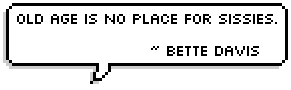
Getting old, or is it "Old Age isn't for Sissies," Nor is Watching It

That's true, but even harder than growing old, feeble, incapable and demented is watching someone else in the process.

At my age, it's pretty rare to still have two living parents.  And both of my parents are alive, but I can't say alive and well.  They haven't been on their own totally independent for years.

At one point my mother seemed perfectly well, and she was my father's caregiver.  Now, she's in much worse shape, mentally and physically than my father.  The differences in order and speed of deterioration are more varied than the wondrous development of a tiny baby  into a crawling infant, walking toddler, curious preschooler and eventually, G-d willing, an independent adult.  As a mother of five, and also a grandmother, I have a very good grasp of how children grow and develop.

Dr. Yael Zeigler, my Bible teacher at Matan loves to show the chiastic structure of Biblical verses and history.  I see the chiastic structure also in life.  I can compare my parents' decline with my grandchildren's growth and development.

Many people say they'd rather die than find themselves senile and dependent, but what happens is that among the things many demented people forget is that very sentiment.