Showing posts with label traditional Jewish food. Show all posts

Saturday, August 26, 2023

Body and Soul: The Torah Path to Health, Fitness, and a Holy Life


Body and Soul: The Torah Path to Health, Fitness, and a Holy Life by Rabbi Alexander Seinfeld (Author), Dr. Daniel Grove MD (Author) is a good practical book about getting healthier despite being part of a culture and society that promotes overeating. 

Yes, I said it. Traditional Jewish life, nowadays isn't very healthy, and to be honest secular life isn't any better. One big difference is that eating plays a major part in Jewish Life, and most people would be embarrassed to serve a meal that looks "frugal," which can be a negative way of describing a healthy meal or kiddush.

Body and Soul conveniently includes an extensive section with the calorie count of favorite Jewish foods including things like gefilte fish and kreplach.

Personally, I've spent my entire life trying to keep my weight down, and usually failing, though I don't eat the sort of menu Seinfeld and Grove consider typical. I hate to think of what I would look like and my health if I ate that typical high sugar and fat menu.

Early in Body and Soul we read of the dangers of sugars, yes, there are many different kinds, and the many seemingly "healthy" foods rich in it. Rabbi Seinfeld and Dr. Grove also explain how to calculate the amount of calories each individual needs to maintain present weight and a realistic amount to reduce to lose weight safely. 

Because food and ritual eating is such an intrinsic part of Judaism, Body and Soul definitely has a market. Rabbi Seinfeld and Dr. Grove have written a very Jewish diet guide including typical, for many frum people, Shabbat/Chag menus, including what one noshes on at a kiddush. If you pencil in the calorie counts (from the guide at the end of the book) next to what you normally eat and then add it up, the chances are that you'd be horrified.

My most successful weight loss periods were when I kept a food chart, writing down what and how much I ate, plus the calorie counts. If you use a smart phone, that may be the best tool. There's probably an app which will make it easier. Rabbi Seinfeld and Dr. Grove also say that you really must know and keep track of what you eat. One of their tips is not to take second portions. For many people that makes a big difference in total calorie intake. And your total calorie intake is what's most important.

I would just like to add one of my suggestions. Simplify what you serve; make life easier and healthier. Don't give too many choices, because most people will try everything and eat more than they should. Serve just one carbohydrate. There's no reason to have both potato kugel and roasted potatoes. If you follow the custom of two and three kugel Shabbat, make spinach kugel, carrot kugel, along with either a noodle or potato kugel. There's no need to have three types of fleishik. One's enough, especially if you've started the meal with the first course of fish. Make lots of fresh salad and a choice of simple vegetables, no sugar/jam/honey added.  

Body and Soul: The Torah Path to Health, Fitness, and a Holy Life is a very readable book and can really help people by opening their eyes and making them aware of what's in the food they eat. I recommend it as a very good start in improving one's and one's family's life and health.

Product details

  • Publisher ‏ : ‎ Jewish Spiritual Literacy Press (June 1, 2023)
  • Language ‏ : ‎ English
  • Paperback ‏ : ‎ 510 pages
  • ISBN-10 ‏ : ‎ 1680259156
  • ISBN-13 ‏ : ‎ 978-1680259155

Wednesday, October 02, 2019

Tasty and Simple 21st Century Tzimmes


Tzimmes 
Tzimmes is a very traditional holiday food for Ashkenaz (European) Jews. There are still families who make it is a "one pot meal" with beef. That combination is from the days when most meals were thick soups or stews. Today's affluence has enabled the development of multiple-pot meals. Even in the half century I've been married, menus and cooking has gotten much more complicated. There are many more pots in the sink than a couple of decades ago, even though we are fewer people at the table. No doubt my grandmothers would find my tzimmes a bit strange, though familiar.

Ingredients (exact quantities aren't necessary)
1 larger or 2 medium carrots
1 medium sweet potato
piece of dlaat, pumpkin or similar preferable orange-colored squash 4"x4" or 10cm by 10cm
1 large apple
handful of raisins
handful of prunes
cinnamon to taste
approx 1/3 cup dark brown sugar
optional- a few slices of ginger root
2T vegetable oil
water up to 1/3 height of vegetables in pot
bit of coarse salt and black pepper to taste

Instructions
  1. slice carrots thick
  2. cut other vegetables into large bite-sized pieces
  3. place in pot, carrots first, then dried fruit and then the rest
  4. top with sugar and cinnamon
  5. add oil, water and cover
  6. bring to a boil, then simmer until soft
  7. add salt and pepper when cooking
Tasty with meat, poultry fish or add tofu or beans as a vegetarian meal.

Tuesday, April 30, 2019

Homemade Challah, Yes, Passover's Over


Yesterday I made a nice batch of challah, which should be enough for more than a month. I used a very simple challah recipe and no electric mixer. I knead by hand.


Ingredients:
1 cup sugar (I use dark brown)
2 Tablespoons or a bit more of dehydrated yeast
approximately 2 kilo flour (I use whole wheat extra fine)
pinch of coarse salt
3 1/2 cups of warm water
1 cup of any vegetable oil
2 eggs (optional)
1 egg for painting to make a shiny challah

Instructions:
  1. Put almost all of the dry ingredients into a large bowl; just use a cup of flour.
  2. Mix
  3. Add the warm water.
  4. Cover with plastic.
  5. When it looks all bubbly and has risen add the oil (and eggs).
  6. Mix
  7. Gradually add flour, mixing all the time, until you can knead it.
  8. Knead for about 8 minutes.
  9. Coat completely in a bit more oil.
  10. Cover and wait until doubled in size, anything from 20 to 40 minutes depending on the weather and quality of yeast.
  11. Punch down, then cover and wait again. 
  12. "Take a piece of challah" for the blessing.
  13. Punch down and shape. The shaping as you can see in my photos can be very simple.
  14. Paint with raw egg and let the challot rise a bit.
  15. Bake. Don't preheat oven. First I let the shaped challot, more like rolls, rise in 100c, 212f oven until doubled. Then I baked it at 190c, 374f until starting to brown. Finally lower heat to 160c, 320 until a sort of hollow sound when tapped on bottom. Times depend on size of challah and your oven. Mine is turbo/fan and I have heat from bottom. Usually I bake on two racks, also.
  16. It's ready when hard on the bottom and has a hollow sound when tapping the bottom.
  17. Let cool out of the oven.
  18. Enjoy for Shabbat, Jewish Holidays or whenever you want a special bread.

Afterwards I bagged and froze the challah, since it was only Monday, but the house had that wonderful smell of home-baked challah for the rest of the day.

Tuesday, November 13, 2018

"How to Make Challot" in Pictures

You can get a more detailed challah recipe here/click.

Challah Baking Tip:
And a new "kneading technique" for those who knead by hand. Call a friend, talk via "speaker" while kneading and you'll find you can knead forever.
homemade challah

homemade challah

homemade challah

homemade challah

homemade challah
hafrashat challah, mitzvah

homemade challah
hafrashat challah, mitzvah

homemade challah

homemade challah

Sunday, September 23, 2018

Glad We Don't have Strict/Rigid Food Traditions

No, I'm not talking about kashrut,which is Jewish Law, not tradition.

The only really required food is mtazh for the Passover Seder and the special ritual food at the seder. And there are different customs concerning exactly what is to be eaten.

When people tell me they must cook a certain food for a certain holiday with the exact side dishes, recipe etc, no flexibility... And then they get all stressed, because a crucial ingredient can't be bought.

Thank Gd I didn't grow up in a home like that. And I didn't raise my family to expect specific menus, foods etc.

It makes my life so much easier and so much more foun.

Now that we're empty-nesters, we need less food. This year, for the first time, and maybe I'll do it again, I served the same thing before and after Yom Kippur. For years I made a totally different meals. This year I decided that it wasn't worth the bother.

By not having rigid menus, I can be spontaneous is there is a sale on a certain food. I can invent a recipe.

I'm glad it works for me and my family.


Thursday, September 20, 2018

Pre/Post Yom Kippur Meal

Since we have a rather empty nest, just my husband and myself, I don't need to cook as much as before when the house was full of kids and guests. And we still have lots of big pots.

Don't get me wrong; we do have guests, but not as many as in the past. Also, nowadays, my cooking experiments aim more for efficiency than impressive. That's why I decided to try a Pre/Post Yom Kippur Meal, serving (almost) exactly the same meal before and after the Yom Kippur 25 hour fast. Of course, this dish is perfect any time you want an easy hearty one-pot meal.

I don't have many real Jewish Food traditions, especially as pre/post fasts or Succot and Shavuot, which weren't at all celebrated by us. I didn't grow up with kreplach, which is what many Jewish families eat as Pre/Post Yom Kippur Meals.

For some strange reason, as I was trying to figure out what to serve Tuesday night before Yom Kippur, barley popped into my mind. The experts say we should have a complex carbohydrate as a main part of the pre-fast meal. I decided to cook up chicken with barley and vegetables, a one-pot meal, which can even be a soup.


Before the fast, I served it with a salad, and breaking the fast I heated up some ratatouille, I had in the fridge. I also served myself some of the liquid with a bit of whatever came along as a soup, while my husband had his chicken soup. It was delicious, satisfying and so easy to make and serve. I tried to calculate cooking exactly what we needed for the two meals. In the end there's some barley left over, which can be "recycled" into a new soup with added vegetables.

Ingredients:
chicken, I cut it into large serving size pieces
about a cup of barley
onion, cut
2 carrots, cut large
2 large squash, cut large
seasonings, paprika, black pepper, garlic, parsley, a pinch of salt
water, of course

Instructions:
  1. add all ingredients to a large pot, leaving a good inch before top, so it won't boil over
  2. bring to a strong boil and then turn down flame to simmer for an hour or so
  3. Yes, that's it!

Thursday, August 30, 2018

Homemade, Handmade Challah So Simple


Above are the challah ingredients, written rather simply. I keep this note on the fridge. I used to have an index card box with recipes, but they got trashed long before the cookbooks. In all honesty, I don't remember where the recipe came from. It sort of evolved, and it's a bit different every time I make it. I don't have a functioning mixer and haven't had one for ages. I bake "by hand." And I don't have the strongest of hands. It's not all that hard, though you can use a mixer dough hook if you want. The kneading will just take less time.

A few years ago, when my friend got her "new kitchen," she did a chanukat hamitbach, kitchen dedicating/opening ceremony by inviting lots of friends to a challah-baking evening. It was led by a neighbor who showed us how challah-baking is a very spiritual time, and as we physically handle the dough we should be praying and blessing our family, our children and grandchildren.

Ingredients:
1 cup sugar (I use dark brown)
2 Tablespoons or a bit more of dehydrated yeast
approximately 2 kilo flour (I used 70% whole wheat extra fine)
pinch of coarse salt
3 1/2 cups of warm water (4 cups if no eggs)
1 cup of any vegetable oil
2 eggs (optional)
1 egg for painting to make a shiny challah

Instructions:

  1. Put almost all of the dry ingredients into a large bowl, but just use a cup of flour.
  2. Mix
  3. Add the warm water.
  4. Cover with plastic.
  5. When it looks all bubbly and has risen add the oil (and eggs).
  6. Mix
  7. Gradually add flour, mixing all the time, until you can knead it, without getting your hands all sticky.
  8. Knead for about 8 minutes.
  9. Coat completely in a bit more oil.
  10. Cover and wait until doubled in size, anything from 20 to 40 minutes depending on the weather and quality of yeast.
  11. Punch down, then cover and wait again. 
  12. "Take a piece of challah" for the blessing.
  13. Punch down and shape. The shaping as you can see in my photos can be very simple.
  14. Paint with raw egg and let the challot rise a bit.
  15. Bake. *Start in a hot oven, and then lower temperature when you can see the challah begin to brown a bit.
  16. It's ready when hard on the bottom and has a hollow sound when tapping the bottom.
  17. Let cool out of the oven.
  18. Enjoy for Shabbat, Jewish Holidays or whenever you want a special bread.
PS They freeze well.

*There are too many factors to predict exact baking time. For temperatures I think that I started baking close to 200c and ended more like 170c. But remember that each oven is different, and it depends on whether you're doing turbo and how many trays etc. Of course Farenheit numbers are different.


Monday, April 02, 2018

Cooking Up a Storm for The Kiddies

We set up a second table in order to accommodate the clan yesterday. There were chairs out for all but the youngest, who's under a month old. Just because I'm no longer in the Passover Seder business doesn't mean that I'm neither hosting nor cooking for them. Not only did I have everyone over for our traditional family Pesach food, but I served on real plates. And I even washed up all the dishes, pots and pans afterwards.

Photo by Yisrael Medad,
Yes, the husband
The highlight of the menu was Savta Brei, a calorie laden dish that can be described as "latke-coated matzah" fried in olive oil. Basically, it's just a matter of taking onions and potatoes, grating (you can use a blender or food-processor) them together, mix with eggs, matzah meal, salt and pepper. Yes, just like classic raw potato latkes. Heat some oil in the frying pan, then take matzah, coat with the mush and fry well on both sides. Serve it with applesauce and/or sour cream, just like you'd do with potato latkes.

I'm not quite sure that anyone ate them besides my children. Since the frying went really slowly due to the lack of a good gas stove, I baked up some of the mush as oven latkes. But my husband was overjoyed to have the traditional holiday food of his family. The latkes were more popular with the younger generation and the in-laws.

For my children, I decided to serve one of their childhood Passover treats,  Instant Chocolate Pudding. It had been decades since such a dish had graced our table. As an extra adventure, the grandkids were introduced to what was once the most necessary Passover kitchen tool, the eggbeater. Some of the older ones took turns trying to mix the chocolate pudding with it.

I think everyone had a good time. There was just one almost disaster. The folding table began spontaneously folding mid-meal. Luckily I was sitting at the end and held it up until my son-in-law reopened it. Nothing was lost, especially not weight. We will have to resume our diets after Pesach.

The farewell blessing was:
"Next year in a new kitchen."
Gd willing, speedily in our days...

Monday, April 10, 2017

Easy TNT Never-Fail Knaidlach, Matzah Balls

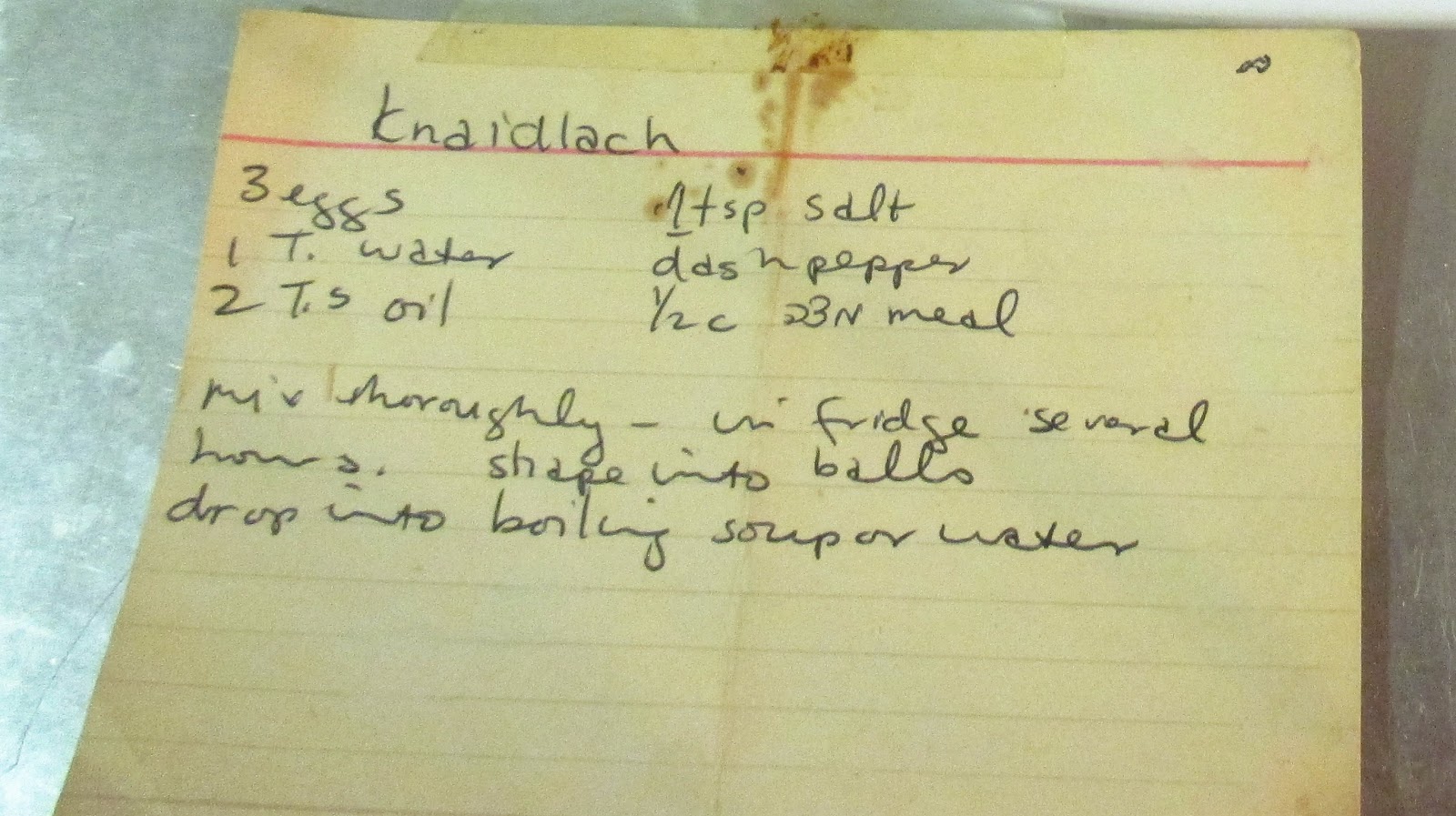
I discovered this super easy, never failed me yet, TNT tried and true  Matzah Ball recipe when I was newly married a gazillion years ago. I use olive oil when making it on Passover and vegetable/soy oil during the year. It's best cooking it up in the soup, chicken or even vegetable soup, but when I bring them to my daughter, I just cook them up in lightly salted water. This time the water also had a pinch of pepper.


Way back when, every good housewife had a little Recipe Box of handwritten index cards, I wrote this one:

3 eggs
1T water
2 Ts oil
1 tsp salt
dash pepper
1/2 c מצה meal

mix thoroughly

-in fridge several hours
shape into balls
drop into boiling soup or water

Here are pictures from this year when I quadrupled the recipe:


I'm just bringing the Matzah Balls, since my daughter is hosting and making the Chicken Soup.

****

This, how to double-spoon drop for making Kneidlach, is from last year, when I was cooking on gas, which gives a more powerful flame than the electric stove I'm using this year. Gd willing, next year I'll be back to cooking on gas, or at  least a more powerful stovetop.

Thursday, November 24, 2016

Coney Island Knishes in Jerusalem

I must admit that I wasn't raised on knishes, but the other day while walking on Jerusalem's Jaffa Street, I stopped into the Coney Island, meal, snack, pretty much anything at great prices food place, see my post: Best Sandwich Deal in Jerusalem, NS10, and ended up getting a couple of knishes.

One was classic potato, and the other was spinach. Admittedly, I'm not a real knish-maven, but I was raised on Jewish-Ashkenaz food in New York. I have memories of potato and kasha knishes, but not spinach ones. I ate the potato one on the spot, and it was OK but I'm not a potato fan at all. I was just very hungry and needed an energy boost-- eeks! I really didn't need all those calories.

There were so many delicious and lower calorie foods to choose from, but after teaching I needed a treat. They provide friendly service and even have salads. But I rationalized that I needed to blog for people who aren't on perennial diets also. Right?

By the time I finished the potato knish I really wasn't hungry. It's not like having chocolate or one of their gorgeous and tempting cupcakes, which I still haven't tried, which always whet the appetite and makes you want even more. The knish is food and satisfying.

So, I stored the spinach knish in my friend's fridge and then took it with me the next day. I ended up heating up in the Teachers Room and eating it as a very necessary pre-lunch snack, since breakfast had been super early and lunch wasn't going to be for a couple of hours. I gave it good heating in the microwave.


And it was truly delicious.

Wednesday, October 05, 2016

Tzimmis or Tzimmes! Spelling Doesn't Count, Just Yummy

How can there be Rosh Hashanah sans Tzimmes? My recipe does evolve and change from year to year, but on Rosh Hashanah, there must be a sweet orangey vegetable dish aka Tzimmis!


This year I made mine with:

  • a bit of onion
  • carrots
  • sweet potato
  • pumpkin
  • prunes
  • brown sugar
  • cinnamon sticks
  • spoon or two of oil
  • water
All that went into a pot, which was covered and cooked on a low heat until soft and ready. It's that easy. The carrots are on the bottom and the pumpkin on top, since carrots take longer to cook.

Gmar Chatima Tovah
Have a Very Sweet Year!

Wednesday, September 16, 2015

Cooking Up a Storm, Healthy Traditional Jewish Food

I haven't posted recipes for quite a while. Every time I cook it seems like I'm making some new version of old favorites. So, in some ways my food is all the same, but in many ways it's different.

This year's tzimmes has most of the usual ingredients, but is lighter than many:

Tzimmis ingredients, all cut, before adding water, to almost cover.
Relative quantities aren't that important:

  • prunes
  • raisins
  • carrots
  • sweet potatoes
  • apple
  • cinnamon
  • nutmeg
  • fresh ginger root
  • dark brown sugar
  • water to almost cover
Cook it all on low flame in covered pot until soft. Yes, that's it.

With my very flexible and simple basic cake, I made an Apple-Fig Upsidedown Cake for Rosh Hashanah! Here's the simple one-bowl recipe. 
This is the basis for all sorts of cakes, including chocolate, apple, chocolate chip, etc. It can be multiplied, and I never make it with less than 3 cups of flour. Of course, it can be frozen and iced. I make it with whole wheat cake flour and brown sugar.
1 cup flour
1/2 cup sugar
1 t baking powder
1/6 cup oil (soy)
1/2 cup water
1 egg
1 t vanilla
mix dry ingredients
add oil and water
mix
add eggs
mix
pour in pan
bake medium heat* 
until pops up when gently pressed in center of cake


This time I added cinnamon and nutmeg to the batter instead of vanilla.


On the bottom of the cake pan I put sliced apples and fig "jam." Then I poured on the batter and baked. It was a great success.

I also made Apple Cake with the same batter. I diced up some apple and placed the pieces in the cakepan. Then I poured in the batter and mixed.


They all baked up beautifully. It's very easy! I froze the apple cake and two little ones I made with the batter for later eating.

Cooking does not have to be difficult and stressful. I find that having simple basic recipes that can be varied is the best way to cook and enjoy myself. I can be creative and not get all hysterical and OCD over finding exactly the "right" ingredients. I base my cooking on what I have and what is easily available and reasonably priced. 

*My oven does not have regular temperatures, and I just "know" where the dial should be. For baking a cake I set the dial at just after 5 o'clock, if that helps you.  If the top seems cooked, while the batter is still watery, lower the heat.

Wednesday, April 08, 2015

Low Carbohydrate "Savta Brei," Great Reviews

For the first time possibly ever, my cousin and her husband came over for lunch without the kids. We are all empty-nesters with adult and married kids. In recent years we've taken one-day trips by ourselves during Passover and Succot, but they had never just come for lunch.

I decided to do a new version of the old menu I'd serve way back when, when they'd show up with all of their kids on Passover. That's based on my legendary "Savat Brei," a dish only my mother-in-law ever made. I've never seen such a recipe any place but in her culinary repertoire. Simply described, it's Chanukah potato latkes spread on both sides of a matza and fried. I call it "Savta Brei," because she called it "Matzah Brei," and Savta is the Hebrew for Grandmother, and my kids called her "Savta."

Decades ago, when I'd host my cousin's clan and we were all much younger and slimmer, I'd make the "latkes mush" out of grated or blenderized potatoes, onions, eggs, matzah meal, salt and pepper. But now that my cousin and I are the "savtot," plural for savta, I decided that we'd be better off with a new streamlined low carbohydrate version.


Squash, carrot, celeriac and onion

I substituted low carbohydrate vegetables, squash, carrot, celeriac and onion for the potatoes. Instead of hand-grating, I used the blender and a few eggs.


Then I mixed, adding, salt, pepper and matzah meal until it wasn't too runny. I heated up olive oil (the only oil I buy for Passover--but any vegetable oil can be used) in the big frying pan, coated both sides of the pieces of matzah with the mush and fried, turning over when cooked.

I served it with yogurt, but you can also use sour cream, apple sauce or even jam or honey if calories and sugar aren't your problem.

Of course, we can't ignore the fact that this does include matzah and matzah meal, but it did make a fun and filling meal and less/fewer glycemic carbohydrates than the traditional potato version. And of course we served it with a fresh salad.  My guests loved it! The "mush" can also be baked into a kugel. I then add a bit of oil on top before baking. And the "mush" can also be fried or baked into "latkes."